New Patient Offer
$79
A $400+ Value
- Exam
- X-rays
- Cleaning
- Treatment Plan


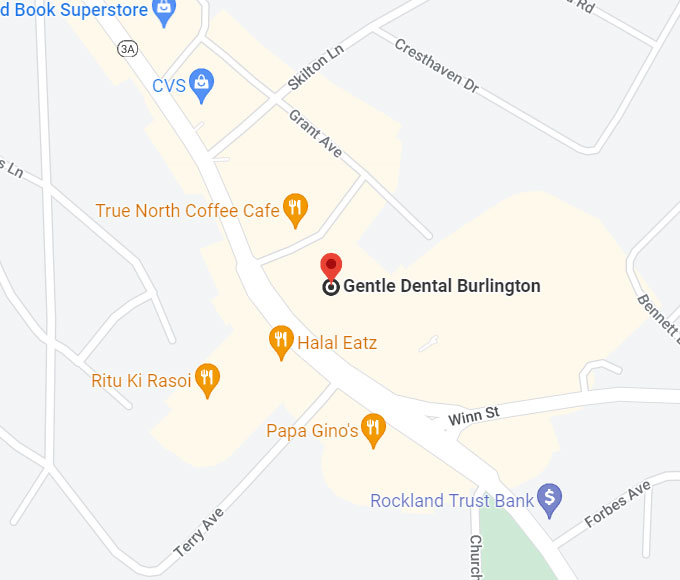
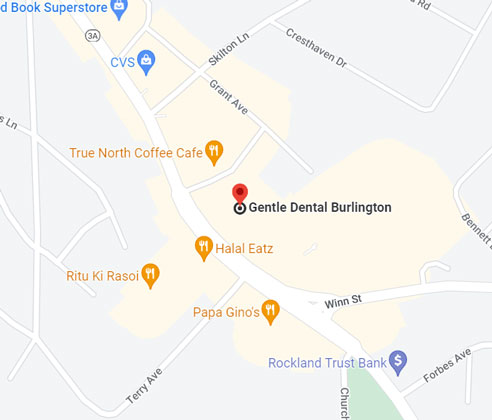
Parking spaces available in front of building. Parking lot on-premise.
Now welcoming patients from Gentle Dental Woburn.
Parking spaces available in front of building. Parking lot on-premise.
Now welcoming patients from Gentle Dental Woburn.
Burlington

I had two emergency visits in a week and they took me right away ! They are were all very friendly and kind ! I would highly recommend going to Burlington gentle dental!
Burlington
Very highly skilled practitioners attend to you at this office. They gave me a new perspective of my dental health, with lots of courtesy too. The customer service is excellent. I recommend them to anyone who seriously cares about good dental health.
Burlington
Extracted my broken tooth. Did the procedure during my initial visit with the practice . Very comfortable with the practice. They will become my go to practice moving forward.
A dental bridge may be an option when you have one or more missing teeth and healthy supporting structures around the open space.
Replacing a missing tooth may help prevent neighboring teeth from drifting into the space. However, the right treatment depends on the number and location of missing teeth, the health of the supporting teeth and gums, and the condition of the jawbone.
A fixed dental bridge may be suitable for patients who want to replace missing teeth without wearing a removable appliance.
Your Gentle Dental Burlington dentist will examine your mouth and determine whether a bridge, implant, partial denture, or another restoration is the most appropriate option.
Dental bridges can improve the appearance, function, and stability of your smile after tooth loss. By filling the space left by missing teeth, a bridge may help you chew more comfortably, speak more clearly, and protect the alignment of the surrounding teeth.
A dental bridge replaces one or more missing teeth with a custom restoration designed to fill the open space. Restoring the gap can create a more complete-looking smile and help you feel more comfortable when speaking, eating, or smiling.
Missing teeth can make it difficult to bite and chew certain foods or may cause you to rely more heavily on one side of your mouth. A dental bridge restores contact between the upper and lower teeth, helping distribute chewing pressure more evenly and making it easier to enjoy a wider variety of foods.
Teeth play an important role in forming certain words and sounds. Missing teeth, particularly toward the front of the mouth, may affect pronunciation or allow air to escape while speaking. Filling the space with a dental bridge can help restore the tooth structure needed for clearer and more natural speech.
When a tooth is missing, the teeth next to the open space may gradually tilt, rotate, or move out of position. The opposing tooth may also begin to shift toward the gap. A properly fitted dental bridge helps maintain the position of surrounding teeth and supports a more balanced bite.
Unlike a removable partial denture, a fixed dental bridge is cemented or securely attached to supporting teeth or dental implants. It remains in place while you eat, speak, brush, and complete your daily activities. Only a dental professional can remove the restoration.
A custom dental bridge can be designed to coordinate with the shade, size, shape, and contour of your natural teeth. Careful treatment planning helps the replacement teeth blend with your smile while restoring the appearance of the missing area.
Missing teeth can change how the upper and lower teeth meet, placing additional pressure on the remaining teeth. A dental bridge can help restore proper contact between the teeth and support a more even distribution of biting forces.
Teeth surrounding an open space may receive additional pressure as they compensate for the missing tooth. Replacing the missing tooth with a bridge may reduce strain on the remaining teeth and help support their long-term function.
A visible gap can affect how comfortable you feel in social, personal, or professional settings. Replacing missing teeth with a natural-looking bridge may help you feel more confident when smiling, speaking, and interacting with others.
Your consultation allows the Burlington dental team to evaluate your missing teeth and determine which replacement options may work for you.
Your dentist examines the open space, neighboring teeth, gums, bite, and existing dental restorations. The supporting teeth must be healthy enough to hold the bridge.
Dental X-rays may be used to examine the tooth roots, surrounding bone, decay, and other concerns that may not be visible during a clinical examination. Gentle Dental Burlington uses all-digital X-rays in its recently renovated office.
For a traditional bridge, your dentist evaluates the natural teeth on each side of the space. These teeth may need to be reshaped and covered with crowns to support the bridge.
Your dentist may compare a traditional bridge with other options, such as an implant-supported bridge, individual dental implants, or a removable partial denture.
The Burlington team will explain the recommended bridge design, expected number of appointments, treatment timeline, estimated cost, insurance considerations, and care requirements.
Gentle Dental states that fixed bridge treatment usually involves several appointments. The exact number of visits and treatment timeline may vary according to your individual needs.
During the first appointment, your dentist may:
Gentle Dental indicates that patients may wear the temporary bridge for approximately three weeks while the custom restoration is being fabricated.
At the next appointment, the dentist may remove the temporary bridge and evaluate the foundation or framework of the permanent restoration.
The dentist checks the fit and selects a porcelain shade that coordinates with the adjacent teeth. The temporary bridge may then be cemented back into place while the final restoration is completed.
Gentle Dental states that the permanent bridge is typically ready at a follow-up visit approximately two weeks after the framework appointment.
The dentist will also explain how to brush, floss, and clean beneath your new bridge.
A temporary bridge protects the prepared teeth while your permanent restoration is being made. Because temporary cement is designed for short-term use, the bridge may be easier to loosen or damage.
Do not use household glue to reattach a temporary bridge. Contact Gentle Dental Burlington for professional guidance.
Both bridges and implants replace missing teeth, but they use different forms of support.
A traditional bridge is supported by crowns placed over neighboring natural teeth. Preparing these teeth requires the permanent removal of some enamel.
Bridge treatment is generally completed faster than implant treatment because it does not require an implant to integrate with the jawbone.
A dental implant is placed in the jawbone and replaces the missing tooth root. It can support an individual crown or an implant-supported bridge.
Implant treatment usually requires a longer timeline because the implant must heal and integrate with the bone before the final restoration is attached. This healing process may take several months.
Gentle Dental Burlington offers custom crowns and bridges and dental implant services, allowing the team to compare available options based on your needs.
A dental bridge cannot develop a cavity, but the natural teeth supporting it can still be affected by plaque and decay. Food and bacteria may also collect underneath the artificial tooth if the area is not cleaned properly.
Daily cleaning underneath the bridge is particularly important for protecting the supporting teeth and gum tissue.
Dental bridges are durable restorations, but they may eventually need to be repaired, recemented, or replaced. Bridges commonly last approximately five to 15 years, although some remain functional longer with proper care.
Schedule an evaluation if you notice pain when chewing, new sensitivity, bleeding gums, visible damage, or movement in the bridge.
The supporting teeth and surrounding tissue are typically numbed before preparation, helping patients remain comfortable during the procedure.
You may experience mild gum tenderness or tooth sensitivity after an appointment. The bridge may also feel unfamiliar at first while your mouth adjusts to the restoration.
Contact Gentle Dental Burlington if you experience:
A loose bridge should be evaluated promptly because movement may allow bacteria to collect around the supporting teeth or expose weakened tooth structure.
Depending on the condition of the bridge and supporting teeth, the dentist may be able to recement it or may recommend repair or replacement.
Gentle Dental Burlington provides custom crowns and bridges to restore damaged or missing teeth. The office has served the Burlington community for nearly 40 years and features a recently renovated setting, all-digital X-rays, convenient hours, and ample parking.
The cost of a dental bridge varies according to:
Many dental insurance plans may provide partial coverage for a bridge when it is considered medically necessary. Deductibles, waiting periods, annual maximums, and coverage percentages vary by plan.
Gentle Dental accepts more than 200 dental insurance plans. The Burlington office also provides access to the Essential Dental Plan and third-party financing options. The team can review estimated insurance benefits and payment options before treatment begins.
Gentle Dental in Burlington, MA, offers a wide range of dental services, including general dentistry, cosmetic dentistry, orthodontics, and emergency dental care. Our experienced team is dedicated to providing comprehensive care for patients of all ages in a comfortable and welcoming environment. Explore our website for more information and to book an appointment with our skilled professionals.
A bridge may be recommended if you are missing one or more teeth and have healthy teeth or implants available to support a fixed restoration. Your Burlington dentist will examine your teeth, gums, bite, and jawbone before recommending treatment.
Gentle Dental states that a fixed bridge usually requires several visits. Treatment may include preparation and impressions, a framework and shade evaluation, and a follow-up visit for permanent placement.
Gentle Dental indicates that a temporary bridge may be worn for approximately three weeks before the next stage of treatment. The exact timing depends on the laboratory and your individual treatment plan.
Yes. A bridge may replace one tooth or several consecutive missing teeth. The number that can be replaced depends on the location of the gap and the strength and number of available supporting teeth or implants.
A custom bridge can be designed to coordinate with the shade and shape of nearby teeth. Your dentist will evaluate the restoration’s fit, appearance, and bite before permanently securing it.
After the permanent bridge is placed and your dentist confirms that your bite is comfortable, you can generally return gradually to normal eating. Avoid very hard and sticky foods while wearing a temporary bridge.
Regular floss cannot pass directly between the connected replacement teeth. A floss threader, interdental brush, or another dentist-recommended cleaning aid can help remove plaque and food from underneath the bridge.
Dental bridges commonly last approximately five to 15 years, although longevity varies. Daily cleaning, regular dental visits, healthy supporting teeth, and avoiding damaging habits can help extend the life of the restoration.
Many plans may cover part of the cost of a medically necessary dental bridge. Coverage depends on your deductible, annual maximum, waiting period, network status, and individual plan benefits.
If your request is a dental emergency, or you would like to call and schedule your dental appointment, contact information for our offices can be found here: Gentle Dental Locations. New patient offer not valid for emergency appointments.
What is the difference between a crown and a bridge?There are a lot of different...

Just about everyone hopes to keep all of their adult teeth forever. However, in ...

