New Patient Offer
$79
A $400+ Value
- Exam
- X-rays
- Cleaning
- Treatment Plan


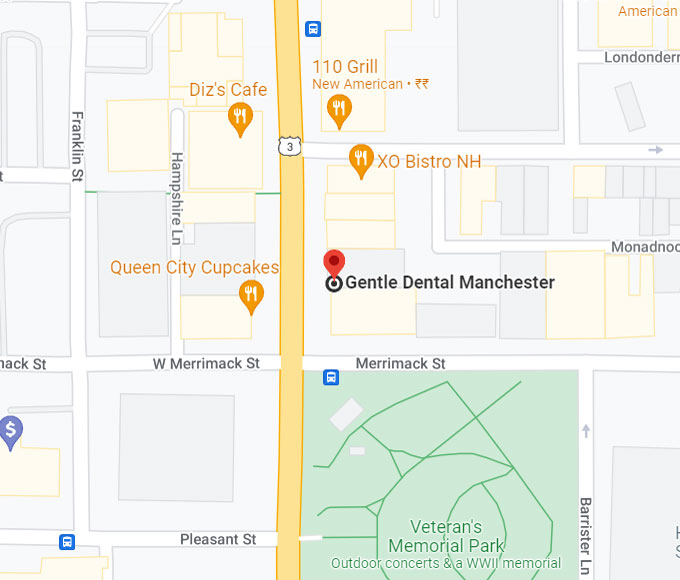
Street parking available.
Street parking available.
Manchester, NH

This is the best dentist in town and likely in the State of NH. They listen, address with a plan, keep you in the loop, are gentle and caring, and fair when it comes to financial matters. They were the only dentist after three to provide me a good final solution to my dental concern. Visit them, you won’t be disappointed, probably surprised. Thank you very much!
Manchester, NH
I had a bit of a dental emergency and I got in right away, not having ever been there before. The staff was so pleasant and seemed so caring. Dr Norton took great care of me and explained my situation thoroughly. I highly recommend them.
Manchester, NH
As someone who a huge fear of dentists I would like to say that going to Gentle Dental was the best choice. They are so kind and compassionate and it helps ease some of my fear of the dentists in general. They were warm welcoming and understanding. They went above and beyond to help me stay relaxed and they listened to what I had to say. I can honestly say that I'll be back and be happy to see them at the next visit.
Jaw discomfort can affect chewing, speaking, yawning, and other routine movements. Gentle Dental provides TMD and TMJ treatment at its Elm Street office for patients experiencing ongoing jaw pain, restricted movement, painful clicking, locking, or discomfort associated with teeth grinding and clenching.
Although many people use “TMJ” to describe the condition, TMJ refers to the temporomandibular joint itself. TMD refers to a group of disorders involving the jaw joints, chewing muscles or related structures.
Because jaw discomfort can have several possible sources, treatment begins with an evaluation rather than a one-size-fits-all recommendation. Your dentist will review how your jaw moves, where discomfort occurs, and whether your teeth, muscles, or joints may be contributing to the problem.
The goals of TMJ treatment depend on the type of disorder and how it affects your daily activities.
Treatment may help reduce strain on the jaw joints and chewing muscles. Improving jaw movement can make it more comfortable to eat, speak, and open or close your mouth.
Repeated grinding or clenching can place pressure on the jaw muscles, joints, and teeth. When these habits contribute to your condition, treatment may focus on reducing muscle tension and protecting the teeth from additional wear.
TMD can interfere with meals, conversations, sleep, and routine dental care. A treatment plan may help improve function while reducing activities or habits that place unnecessary stress on the jaw.
Patients who grind their teeth may develop flattened, chipped, or sensitive teeth. A dentist may recommend a custom appliance when protecting the teeth is part of the treatment goal.
Not every jaw sound requires treatment. Clicking or popping without pain or limited movement is common and may not require care. An evaluation may be appropriate when jaw problems are persistent, painful, or interfere with function.
Pain or tightness in the jaw muscles or joints may become more noticeable while chewing, speaking or waking in the morning.
Jaw sounds may require evaluation when they occur with pain, restricted movement, or episodes in which the jaw becomes difficult to open or close.
Morning jaw fatigue, worn teeth, or awareness of nighttime grinding may indicate that excess pressure is affecting the teeth and jaw muscles.
Limited jaw movement can make eating, yawning, or receiving dental treatment more difficult. The dentist can evaluate whether the limitation is related to muscle tension, joint movement, or another condition.
Some patients experience discomfort around the temples, cheeks, ears, neck, or head that becomes worse with chewing or jaw movement. Because these concerns may have causes unrelated to TMD, a careful evaluation is needed before treatment is recommended.
There is no single test that diagnoses every temporomandibular disorder. Your dentist will combine information from your health history, symptoms, and clinical examination to determine the appropriate next step.
Your dentist may ask when the discomfort began, how often it occurs, and which activities make it better or worse. The evaluation may also cover:
The dentist may observe your jaw as you open, close and move it from side to side. The examination may include checking:
Dental X-rays may be used to evaluate the teeth and jaw. More detailed imaging may be recommended when the dentist needs additional information about the joint, bone or surrounding soft tissue.
Imaging is selected according to your clinical findings. Not every patient requires the same type of scan.
After the evaluation, your dentist will explain the findings and discuss appropriate options. Care often begins with conservative, reversible approaches before more complex procedures are considered.
TMD includes several different joint and muscle conditions, so the recommended treatment can vary from one patient to another.
Initial care may include temporarily choosing softer foods, avoiding gum chewing and reducing habits that place pressure on the jaw. Your dentist may also discuss relaxed jaw posture, stress-related clenching and activities that contribute to discomfort.
Heat, cold or gentle exercises may be recommended for certain patients. Follow the instructions provided by your dental or medical professional rather than beginning exercises that have not been selected for your condition.
A dentist may recommend a removable oral appliance when grinding, clenching or tooth wear contributes to the problem. The appliance is designed to fit over the teeth and may help protect them from repeated contact.
An oral splint should not be designed to create permanent bite changes. Contact the dental office if an appliance increases pain or causes a new change in how your teeth meet.
Physical therapy may be appropriate when treatment needs to address jaw movement, muscle tension, posture or related neck discomfort. A dentist may coordinate care with a qualified physical therapist when this approach fits the diagnosis.
Medication may be considered for short-term management of pain, inflammation or muscle spasms. The appropriate medication depends on your health history, symptoms and other medicines you take.
Only take prescription or over-the-counter medication as directed by an appropriate healthcare professional.
The Manchester Elm Street office lists Botox and injectable services for facial aesthetics and TMJ relief. Injectable treatment is not appropriate for every TMD condition and is not a substitute for identifying the source of the problem.
Your dentist can explain whether this option should be considered, what limitations apply and whether a more conservative approach is preferable.
Procedures involving the jaw joint are generally reserved for specific conditions that have not responded to appropriate conservative care. When advanced evaluation or treatment is required, the dental team can explain the next step and whether coordinated specialty care is needed.
Your appointments will depend on the findings from your initial evaluation and the treatment selected.
The first visit focuses on understanding the problem. Your dentist will review your concerns, examine the jaw and teeth and determine whether imaging or another evaluation is needed.
You will have an opportunity to discuss how the discomfort affects eating, sleeping, speaking or other activities. The dentist will then explain whether treatment at the dental office is appropriate or whether another healthcare professional should be involved.
When a custom oral appliance is recommended, treatment generally includes several stages.
The dental team will capture the shape and position of your teeth so the appliance can be created for your mouth.
The dentist will place the completed appliance, evaluate its fit and explain when and how to wear it.
Follow-up visits allow the dentist to check the appliance, your bite and your response to treatment. Adjustments may be needed as treatment progresses.
TMD treatment may require more than one approach. Your dentist will monitor whether jaw comfort, movement and daily function are improving and modify the plan when appropriate.
Contact the office if symptoms worsen, the appliance no longer fits or you notice a new change in your bite.
Daily habits can affect the amount of pressure placed on the jaw joints and muscles.
Your dentist may recommend limiting hard or chewy foods during a flare-up. Avoid chewing gum, biting pens, holding objects between your teeth or using your teeth as tools.
Try to keep your jaw relaxed when you are not eating or speaking. The upper and lower teeth generally should not remain tightly together at rest.
Heat or cold may help certain types of jaw discomfort. Gentle stretching or strengthening exercises may also be included in a treatment plan.
Use these approaches only as directed because the appropriate method depends on the source of the problem.
Clean and store the appliance according to the instructions provided by the dental team. Bring it to follow-up appointments so the dentist can inspect its condition and fit.
Do not continue wearing an appliance that causes increasing pain or creates a noticeable change in your bite without contacting the office.
Contact a healthcare professional if your jaw becomes locked, you cannot open or close your mouth normally or discomfort becomes severe. Facial swelling, fever, difficulty breathing or difficulty swallowing may require urgent medical evaluation.
Gentle Dental Manchester lists TMD and TMJ treatment among the services available at its Elm Street location. Patients can begin with a local dental evaluation rather than trying to determine the source of jaw pain on their own.
Jaw pain does not always come from the temporomandibular joint. The Manchester team evaluates the jaw, muscles, teeth and bite before recommending treatment.
This approach helps the dentist distinguish between concerns that may respond to dental treatment and those that may require coordinated medical or specialty care.
Many TMD concerns can be managed with reversible, nonsurgical approaches. The team can review habit changes, oral appliances and supportive therapies before more complex options are considered.
Treatment recommendations are based on the clinical findings rather than applying the same appliance or procedure to every patient.
The Elm Street office uses digital X-rays and advanced imaging to support diagnosis and treatment planning. Imaging may help the dentist evaluate the teeth, jaw and surrounding structures when it is clinically necessary.
When grinding, clenching or tooth wear contributes to a patient’s concerns, the dentist can determine whether a custom oral appliance is appropriate.
The treatment includes fitting instructions and follow-up evaluations instead of relying on a generic over-the-counter device without professional assessment.
Gentle Dental Manchester provides general and specialty services under one roof. Related care may include dental exams, digital X-rays, restorative dentistry, sleep apnea treatment, orthodontics, sedation dentistry and injectable services.
Access to multiple dental services can make it easier to coordinate treatment when the jaw concern overlaps with tooth wear, bite changes, sleep-related concerns or other oral health needs.
The Manchester Elm Street office provides evening and weekend scheduling. This allows patients to arrange evaluations and follow-up visits around work, school and family responsibilities.
Appointment availability varies, so patients should contact the office for current scheduling options.
Gentle Dental Manchester accepts most major insurance plans. Coverage for TMD evaluation, imaging, oral appliances or related treatment varies between dental and medical insurance policies.
The office team can help review available benefits. A consultation is required for treatment-specific recommendations and cost information.
The office is located on Elm Street in downtown Manchester. Patients can complete their initial evaluation, dental imaging, and appropriate follow-up care at the same local office.
Our Manchester dental services include preventive, cosmetic, and specialty treatments like cleanings, digital x-rays, teeth whitening, veneers, braces, root canals, and implant restorations. You won’t need a referral with all the general dentists and specialists in our office.
Yes. Gentle Dental provides TMD and TMJ evaluations and treatment at its Elm Street office in Manchester. The dentist will examine your jaw, teeth and surrounding muscles before recommending an appropriate plan.
The dentist will review your health history and concerns, observe your jaw movement and check for tenderness, limited motion, painful sounds or signs of grinding. Dental imaging may be recommended when additional information is needed.
Treatment may include habit changes, self-care guidance, a custom oral appliance, physical therapy coordination or medication-based care. Injectable or advanced treatment may be discussed for appropriate cases after an evaluation.
A custom night guard or splint may be recommended when grinding, clenching or tooth wear contributes to the problem. It may protect the teeth and reduce strain, but it is not appropriate for every TMD condition.
No. Jaw clicking or popping without pain or restricted movement is common and may not require treatment. Schedule an evaluation when the sound is painful, the jaw locks or movement becomes limited.
The timeline depends on the source of the problem, the treatment selected and how your jaw responds. Your dentist will explain the expected follow-up schedule after completing the evaluation.
Coverage varies by dental or medical insurance plan and by the service provided. The Manchester team can help review your benefits, but a consultation is needed for treatment-specific information.
No. Conservative and reversible treatments are generally considered before procedures that permanently change the teeth, bite or jaw joint. Surgery is usually limited to specific severe conditions after other appropriate options have been considered.
You can schedule online through the Gentle Dental Manchester location page or contact the Elm Street office directly. The team will arrange an evaluation based on current appointment availability.
If your request is a dental emergency, or you would like to call and schedule your dental appointment, contact information for our offices can be found here: Gentle Dental Locations. New patient offer not valid for emergency appointments.
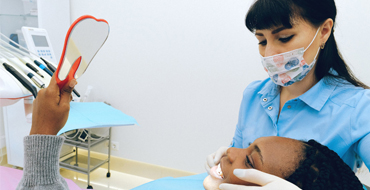
It’s a good thing we can open and close our mouths so that we can do the things ...

