New Patient Offer
$79
A $400+ Value
- Exam
- X-rays
- Cleaning
- Treatment Plan


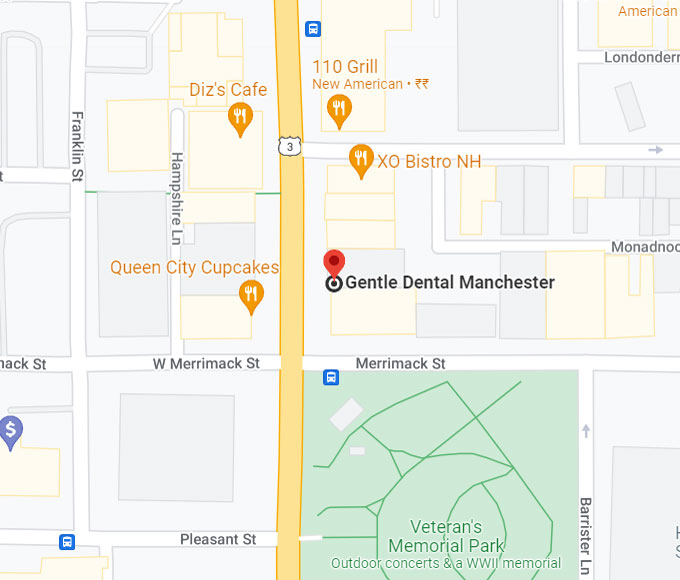
Street parking available.
Street parking available.
Manchester, NH

This is the best dentist in town and likely in the State of NH. They listen, address with a plan, keep you in the loop, are gentle and caring, and fair when it comes to financial matters. They were the only dentist after three to provide me a good final solution to my dental concern. Visit them, you won’t be disappointed, probably surprised. Thank you very much!
Manchester, NH
I had a bit of a dental emergency and I got in right away, not having ever been there before. The staff was so pleasant and seemed so caring. Dr Norton took great care of me and explained my situation thoroughly. I highly recommend them.
Manchester, NH
As someone who a huge fear of dentists I would like to say that going to Gentle Dental was the best choice. They are so kind and compassionate and it helps ease some of my fear of the dentists in general. They were warm welcoming and understanding. They went above and beyond to help me stay relaxed and they listened to what I had to say. I can honestly say that I'll be back and be happy to see them at the next visit.
Tooth removal is typically considered when keeping the affected tooth could cause continued discomfort, infection or damage to nearby oral structures.
Removing a tooth that is badly broken, infected or decayed beyond repair can eliminate the source of dental pain. Your dentist will first determine whether another treatment can save the tooth before recommending removal.
An untreated infection or abscess can affect the tissue and bone surrounding a tooth. Extracting a tooth that cannot be successfully treated may help remove the source of infection and protect nearby teeth and gums.
An impacted, fractured or severely infected tooth may place pressure on nearby teeth or increase the risk of inflammation and damage. Removing the problematic tooth can help preserve the health of the surrounding area.
Advanced periodontal disease can weaken the gum tissue and bone supporting a tooth. Extraction may be recommended when a tooth has become severely loose and cannot be stabilized.
In certain cases, removing one or more teeth can create the space needed to properly align the remaining teeth with braces or clear aligners.
A non-restorable tooth may need to be removed before receiving a dental implant, bridge, partial denture or full denture. Your dentist can discuss replacement options before the extraction so you understand the complete treatment plan.
Having one of these symptoms does not automatically mean your tooth must be removed. A dental examination and imaging are needed to determine whether the tooth can be saved.
Ongoing pain, throbbing or discomfort when biting may indicate deep decay, an infection or damage inside the tooth.
Swelling around a tooth, a tender bump on the gums, drainage or a bad taste in the mouth may be signs of infection or an abscess.
Some damaged teeth can be repaired with bonding, a filling, crown or root canal. Extraction may be necessary when the fracture extends below the gumline or leaves too little healthy tooth structure for a restoration.
Decay can weaken a tooth until a filling or crown can no longer provide reliable support. Removing the tooth may be recommended when it cannot be predictably restored.
A permanent tooth that has become loose because of advanced gum disease, bone loss or trauma should be evaluated promptly.
An impacted tooth remains partially or completely trapped beneath the gum tissue or bone. Impacted teeth, particularly wisdom teeth, may cause discomfort, infection, crowding or damage to adjacent teeth.
An extraction may be included in an orthodontic treatment plan when additional space is needed to properly align the teeth.
The type of tooth extraction you need depends on whether the tooth is visible above the gums, the condition of its crown and roots and its position within the jaw.
A simple extraction is generally used for a tooth that has fully emerged above the gumline and can be accessed without an incision.
The area is numbed with local anesthesia. The dentist then uses specialized instruments to gently loosen the tooth before removing it from the socket.
A surgical extraction may be necessary when a tooth is impacted, broken at or below the gumline or difficult to access.
The dentist or oral surgeon may create a small opening in the gum tissue to reach the tooth. In some cases, a limited amount of surrounding bone may need to be removed or the tooth may be divided into smaller sections for careful removal. Stitches may be placed afterward when needed.
Your treatment will be planned according to the tooth being removed, your medical history, your comfort needs and whether additional treatment is required.
Your dentist will examine the affected tooth, gums, bite and surrounding teeth. Digital X-rays or advanced imaging may be used to evaluate:
The Elm Street office uses digital X-rays and advanced imaging to support accurate diagnosis and treatment planning.
Before treatment, tell the dental team about your medical conditions, allergies, prescription medications, over-the-counter medicines, vitamins and supplements.
Certain health conditions and medications may affect bleeding, healing, infection risk or the type of anesthesia that can be used. Do not stop taking prescribed medication unless the prescribing healthcare provider or dental professional specifically instructs you to do so.
Local anesthesia is used to numb the affected tooth and surrounding tissues. You may feel pressure or movement during the extraction, but you should not feel sharp pain.
Sedation may be discussed for patients with dental anxiety, complex treatment needs or difficulty remaining comfortable during a procedure. The recommended option depends on your health history and the complexity of the extraction.
The dentist or oral surgeon carefully loosens and removes the tooth using the approach established during treatment planning.
The tooth is loosened with specialized instruments and removed from its socket without making an incision in the gums.
A small incision may be created to access the tooth. The clinician may remove a limited amount of bone or divide the tooth into sections when necessary.
After the tooth is removed, the socket is examined and cleaned. The dentist may smooth the surrounding bone or place stitches when needed.
A bone graft may be recommended when preserving the jawbone is important for future dental implant treatment or another restorative plan.
Gauze will be placed over the extraction site to help control bleeding and support the formation of a protective blood clot. The blood clot covers the underlying bone and nerves during the early stages of healing.
Recovery varies according to the location of the tooth, the complexity of the procedure, your general health and how closely you follow the aftercare instructions.
Avoid actions that may disturb the blood clot, including:
Dislodging the blood clot can expose the underlying bone and nerves, increasing the risk of a painful condition called dry socket.
Some tenderness, minor bleeding, swelling or bruising can occur after an extraction. Follow the instructions provided for medication and cold compresses.
Contact the dental office if discomfort becomes severe, suddenly worsens or does not improve as expected.
Choose foods that require minimal chewing during the beginning of recovery, such as:
Avoid hard, crunchy, sticky, spicy or very hot foods until the extraction site has begun to heal.
Continue brushing and flossing the areas away from the extraction site. Avoid brushing directly over the socket until your dental team says it is safe.
Your dentist may recommend gentle rinsing after the initial healing period. Follow the instructions provided rather than using forceful rinsing.
Many patients can return to routine activities within a few days, although the socket and underlying bone take longer to fully heal. More complex surgical extractions may require additional recovery time.
Contact Gentle Dental Manchester if you develop:
Difficulty breathing, significant facial swelling or trouble swallowing may require urgent medical attention.
Except for certain wisdom teeth and teeth removed for orthodontic treatment, an extracted tooth may need to be replaced.
Leaving a space in the smile can affect chewing, appearance and the positions of nearby teeth. Gentle Dental Manchester can evaluate the extraction site and discuss an appropriate replacement plan.
A dental implant replaces the missing tooth root and supports a custom restoration. Implant timing depends on the health of the gums, available bone, infection status and the condition of the extraction site.
A fixed bridge replaces a missing tooth by using the neighboring teeth for support.
A removable partial denture can replace one or more missing teeth and may be appropriate when several teeth need to be restored.
Your dentist will explain the benefits, limitations, treatment timeline and maintenance requirements of each option.
The Gentle Dental Manchester Elm Street team includes an oral and maxillofacial surgeon. This allows patients with surgical or more complex extraction needs to access specialty expertise within the Manchester office.
Extraction is not automatically recommended simply because a tooth is painful or damaged. Our team evaluates whether the tooth can be treated with a filling, crown, root canal, gum treatment or another restorative procedure before recommending removal.
When extraction is the appropriate treatment, we clearly explain the reason and review the available alternatives.
Our Manchester office uses digital X-rays and advanced imaging to examine the tooth, roots, surrounding bone and nearby structures.
Detailed imaging helps the dental team determine whether you need a simple or surgical extraction and plan an appropriate approach for removing the tooth.
Your treatment plan considers both the clinical requirements of the procedure and your comfort needs.
Local anesthesia is used to numb the treatment area and appropriate sedation options may be discussed for patients with anxiety or more complex surgical needs. Our team explains each step so you know what to expect before treatment begins.
The Elm Street location provides general dentistry and specialty services under one roof. This supports coordination between the dentist who diagnoses the problem, the oral surgeon who may perform the extraction and the restorative team that plans tooth replacement.
Patients can receive services including exams, digital X-rays, root canals, extractions, dentures, implant restorations and emergency dental care at the Manchester location.
Severe tooth pain, swelling or a broken tooth may require prompt attention. Gentle Dental Manchester accepts same-day emergency dental appointments and works to see patients as quickly as scheduling allows.
An urgent examination can determine whether the tooth requires extraction or whether another treatment can provide relief while preserving it.
Before you leave the office, the dental team will provide instructions based on your specific extraction. These instructions cover bleeding, pain management, swelling, diet, oral hygiene, physical activity and symptoms that require follow-up.
Our team can also monitor healing and coordinate additional care when a bone graft or tooth replacement is planned.
Gentle Dental Manchester provides flexible scheduling, including evening and weekend hours. This makes it easier to arrange consultations, procedures and follow-up appointments around work, school and family responsibilities.
The Elm Street office accepts most major dental insurance plans. Our team can help review your benefits, expected patient responsibility and available payment options before treatment begins.
Coverage depends on your specific insurance policy, treatment requirements, deductible and annual benefit limits.
Our Manchester dental services include preventive, cosmetic, and specialty treatments like cleanings, digital x-rays, teeth whitening, veneers, braces, root canals, and implant restorations. You won’t need a referral with all the general dentists and specialists in our office.
Yes. Gentle Dental provides simple and surgical tooth extraction services at its Manchester office on Elm Street. The location also offers oral surgery, wisdom tooth removal, bone grafting, emergency dental care, and restorative treatment.
A tooth may need extraction when it has extensive decay, a severe fracture, advanced gum disease, an unsuccessful root canal, infection, impaction, or insufficient space for orthodontic treatment. An examination and X-rays are required to determine whether the tooth can be saved.
Yes. Gentle Dental in Manchester accepts same-day emergency appointments based on availability. Call the office promptly if you have severe pain, swelling, a broken tooth, or signs of infection.
A simple extraction removes a fully visible tooth without creating an incision. A surgical extraction may require an incision, removal of a small amount of bone, or dividing the tooth into sections when it is impacted, broken, or difficult to access.
Local anesthesia is used to numb the tooth and surrounding tissues. You may feel pressure during the procedure, but you should not feel sharp pain. Tell the dentist or oral surgeon immediately if you experience discomfort.
The procedure time depends on the tooth’s position, root shape, condition, and whether the extraction is simple or surgical. Removing one tooth commonly takes approximately 30 to 60 minutes, but complex or multiple extractions may take longer.
Many patients feel ready to return to routine activities within a few days. However, recovery varies, and the gum and jawbone continue healing after you feel better. Surgical extractions may require additional recovery time.
Begin with soft foods such as yogurt, eggs, applesauce, pasta, mashed potatoes, and cooled soup. Avoid hard, crunchy, sticky, and very hot foods during early recovery.
Follow your aftercare instructions and avoid smoking, vaping, drinking through a straw, forceful rinsing, vigorous spitting, and touching the extraction site. These actions can disturb the protective blood clot.
Replacement may be recommended depending on the tooth’s location and the reason for removal. Options may include a dental implant, bridge, or partial denture. Wisdom teeth and teeth removed specifically for orthodontic treatment may not require replacement.
Many dental insurance plans provide coverage for medically necessary extractions, but benefits vary. Gentle Dental Manchester accepts most major insurance plans and can help review your coverage before treatment.
Gentle Dental provides tooth extraction services at its Elm Street office in downtown Manchester. The location offers general dentists, specialty care, digital imaging, oral surgery, emergency appointments, and tooth replacement services under one roof.
If your request is a dental emergency, or you would like to call and schedule your dental appointment, contact information for our offices can be found here: Gentle Dental Locations. New patient offer not valid for emergency appointments.

The goal after a tooth extraction is to protect the blood clot, reduce swelling,...

Some people describe going to the dentist as pulling teeth! But this is far from...

