New Patient Offer
$79
A $400+ Value
- Exam
- X-rays
- Cleaning
- Treatment Plan


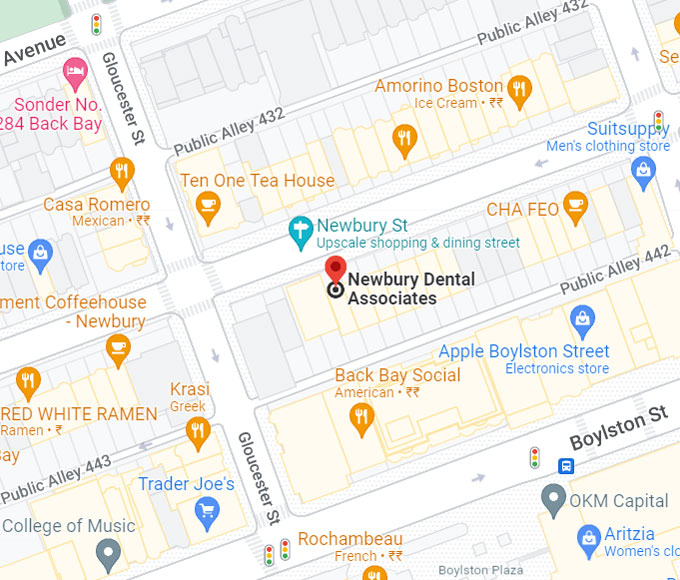
Now welcoming patients from Gentle Dental Boston.
Several parking lots located around Newbury Street, along with parking garage behind building. Street parking is available, but limited.
Now welcoming patients from Gentle Dental Boston.
Several parking lots located around Newbury Street, along with parking garage behind building. Street parking is available, but limited.
Boston

Jessica provides extremely professional service and tries hard to please. At times I think she's overworked but she never ever complains. I'm certainly glad I met her over 10 years ago. Thanks for asking.
Boston
I had to get my wisdom teeth removed and I'm very thankful for Dr. Shadi Daher! I'm a very nervous person when it comes to medical procedures, but Dr. Daher made the procedure very easy for me. Him and the staff at Newbury Dental answered all my questions (which I had many). Thank you!
Boston
I went in for my wisdom tooth extraction for the first time in Boston. The staff was amazing! Dr.He took care of me like a true doctor takes care of his patient. Will definitely recommend this practice to anyone. Dr.Syed
Even with consistent brushing and flossing, plaque can collect along the gumline and in areas that are difficult to clean effectively.
Plaque is a sticky film that forms on the teeth. If it remains in place, it can harden into tartar, also called dental calculus. Unlike soft plaque, tartar cannot be completely removed with regular brushing and flossing and requires professional dental instruments.
Professional cleaning removes these deposits and supports your preventive dental routine.
During a routine cleaning, your dental professional removes plaque and hardened tartar from the surfaces of your teeth and around the gumline.
Removing these deposits is especially important in areas that a toothbrush or floss may not consistently reach.
Plaque accumulation around the gumline can irritate the gums and contribute to gingivitis, an early form of gum disease.
Routine professional cleaning, combined with effective brushing and flossing at home, can help maintain healthier gums and reduce plaque buildup.
Professional cleaning appointments are also an opportunity for the dental team to identify changes involving your teeth, gums, or overall oral health.
Depending on your needs, your visit may also include a dental examination or X-rays to help evaluate areas that cannot be seen during a visual examination.
A routine teeth cleaning in Boston generally includes removing buildup from the teeth and polishing the tooth surfaces. Your visit may vary depending on your oral health and whether additional preventive care is recommended.
Before or during your cleaning, the dental team may evaluate your teeth and gums for signs of cavities, inflammation, tartar buildup, or other concerns.
If there are signs that you may need treatment beyond a routine cleaning, your dentist or hygienist can discuss the findings with you.
Scaling is the process of removing plaque and tartar from the teeth.
Dental professionals use specialized instruments to carefully clean buildup from around the gumline and other areas where deposits have accumulated. Scaling is one of the main steps involved in a professional dental cleaning.
After scaling, the teeth are generally polished.
Polishing helps remove some surface deposits and leaves the tooth surfaces feeling smoother. A routine professional cleaning typically includes both scaling and polishing.
Your dental hygienist may also discuss areas where plaque tends to accumulate and provide recommendations for brushing, flossing, or cleaning between your teeth more effectively.
These recommendations can be adjusted based on your oral health, restorations, orthodontic appliances, or other individual needs.
There is no single cleaning schedule that is appropriate for every patient.
Many patients receive professional dental cleanings approximately every six months. However, people who are more prone to cavities, gum disease, heavy tartar buildup, or other oral health concerns may need more frequent visits. Your dentist should determine the schedule that is appropriate for you.
Factors that may affect how often you need a dental cleaning in Boston, MA include:
Following the schedule recommended by your dental team can help you stay consistent with preventive care.
A routine dental cleaning and a deep cleaning are not the same treatment.
Understanding the difference is important because the appropriate cleaning depends on the condition of your gums and supporting tissues.
A routine preventive cleaning is generally intended for patients whose gums and supporting tissues are relatively healthy.
The focus is on removing plaque and tartar from the teeth and around the gumline to help maintain oral health.
A deep cleaning, also known as scaling and root planing, is a periodontal treatment used when plaque and tartar have accumulated below the gumline and gum disease is present.
Scaling removes deposits beneath the gums, while root planing smooths the root surfaces. This treatment is different from a standard preventive cleaning and is recommended based on periodontal findings.
Your dental team can evaluate your gums and determine whether a routine cleaning or periodontal treatment is appropriate.
You do not need to wait for symptoms before scheduling preventive dental care. Routine cleanings are intended to help maintain oral health before significant problems develop.
However, you may want to schedule an evaluation if you notice:
These symptoms can have different causes, so a dental examination is needed to determine whether a routine cleaning or additional treatment is appropriate.
Bad breath can have many causes, including plaque buildup, food debris, dry mouth, gum problems, certain foods, and health conditions.
If plaque or tartar is contributing to the problem, professional cleaning can remove deposits that regular brushing cannot fully eliminate. However, persistent bad breath should be evaluated because cleaning alone may not address every underlying cause.
Having sensitive teeth does not necessarily mean you should avoid professional dental cleanings.
Tell your dental hygienist or dentist about areas of sensitivity before treatment begins. Your dental team can assess the cause of the sensitivity and adjust your care when appropriate.
Sensitivity can be associated with several factors, including exposed tooth roots, enamel wear, cavities, gum recession, or other dental conditions. Identifying the cause is important when determining the appropriate treatment.
Braces, bridges, crowns, implants, and other dental restorations can create additional areas where plaque may collect.
Professional cleanings can help remove deposits from areas that may be more difficult to reach with daily brushing and flossing.
Your dental team can also recommend cleaning techniques or oral hygiene tools based on the dental work you have.
A professional cleaning is one part of a broader preventive dental care routine.
Gentle Dental's preventive services include dental examinations, professional cleanings, dental X-rays, fluoride treatments, and other care based on the patient's needs.
Your dentist may recommend additional preventive services depending on your age, cavity risk, gum health, dental history, and clinical findings.
Professional cleaning works best when it is supported by consistent oral hygiene at home.
Between appointments:
Home care helps control plaque between professional visits, while dental cleanings remove deposits that cannot be effectively removed at home.
Gentle Dental Newbury St. provides preventive and general dental care at 274 Newbury St., Boston, MA 02116. The office lists preventive cleanings and digital X-rays among the dental services available at the location.
Receiving your preventive care at a multi-service dental practice can also make it easier to coordinate additional treatment if your examination identifies a cavity, gum concern, restorative need, or another dental issue.
For patients looking for teeth cleaning in Boston, the Newbury Street location provides a convenient option in the Back Bay area for maintaining regular preventive dental care.
Schedule your professional dental cleaning with Gentle Dental Newbury St. and keep your preventive dental care on track.
Take care of your smile with a modern, reliable approach to dentistry. Our experienced team creates a welcoming, comfortable environment for expert dental services on Newbury Street, from routine check-ups to advanced care.
Many people receive professional dental cleanings about every six months, but your ideal schedule depends on your oral health. Patients with gum disease, frequent cavities, or greater plaque and tartar buildup may need more frequent visits.
Yes. Gentle Dental's Newbury Street office in Boston lists preventive cleanings among the services available at the location.
A typical dental cleaning includes scaling to remove plaque and tartar followed by polishing of the tooth surfaces. Your visit may also involve an examination, X-rays, or other preventive services depending on your needs.
No. A routine dental cleaning focuses primarily on maintaining healthy teeth and gums. A deep cleaning, or scaling and root planing, treats areas below the gumline when periodontal disease is present.
Regular brushing can remove soft plaque, but once plaque hardens into tartar, professional dental instruments are needed to remove it.
Routine dental cleaning is generally well tolerated, but patients with sensitive teeth, inflamed gums, or heavier tartar buildup may experience some discomfort. Tell your dental team if you have sensitivity so they can consider your comfort during treatment.
The length of a cleaning varies depending on the amount of plaque and tartar buildup, your gum health, and whether additional examination or preventive services are performed.
In many cases, you can eat after a routine cleaning. If you receive an additional treatment such as fluoride, your dental team may provide specific instructions about when to eat or drink.
If your request is a dental emergency, or you would like to call and schedule your dental appointment, contact information for our offices can be found here: Gentle Dental Locations. New patient offer not valid for emergency appointments.

A professional teeth cleaning is essential for long-term health, offering benefi...

