New Patient Offer
$79
A $400+ Value
- Exam
- X-rays
- Cleaning
- Treatment Plan


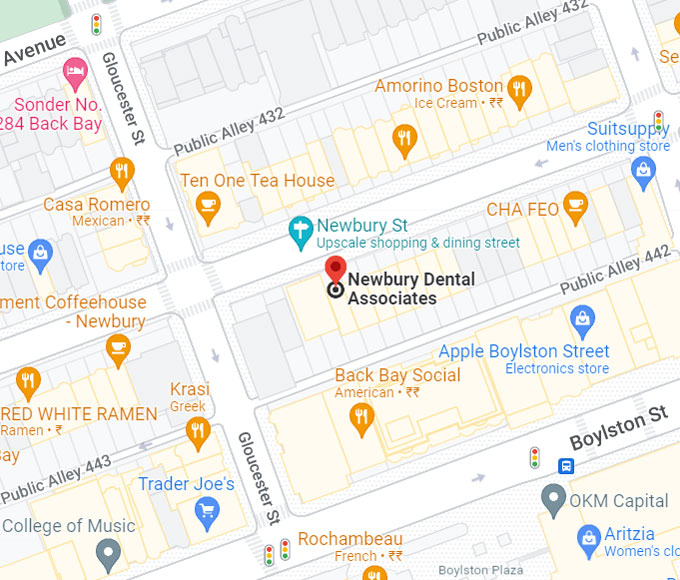
Now welcoming patients from Gentle Dental Boston.
Several parking lots located around Newbury Street, along with parking garage behind building. Street parking is available, but limited.
Now welcoming patients from Gentle Dental Boston.
Several parking lots located around Newbury Street, along with parking garage behind building. Street parking is available, but limited.
Boston

Been going here 25 years. Awesome place. Always on time. Hygienists fantastic. Front desk staff the same. Dr Millen is the best dentist I’ve ever had. And they’ll take care of you if you suddenly need a root canal. They even took care of me after I was laid off & lost my insurance. Plus the Harry Potter store is next door, you can’t go wrong.
Boston
I had to get my wisdom teeth removed and I'm very thankful for Dr. Shadi Daher! I'm a very nervous person when it comes to medical procedures, but Dr. Daher made the procedure very easy for me. Him and the staff at Newbury Dental answered all my questions (which I had many). Thank you!
Boston
I went in for my wisdom tooth extraction for the first time in Boston. The staff was amazing! Dr.He took care of me like a true doctor takes care of his patient. Will definitely recommend this practice to anyone. Dr.Syed
Dental sedation is not only for patients with severe dental fear. There are several situations in which a dentist may discuss sedation as part of a patient's treatment plan.
Some people feel anxious as soon as they think about visiting the dentist. Others may have avoided appointments for months or years because of previous experiences or fear of treatment.
Sedation can help appropriate patients feel more relaxed so they can receive necessary dental care. Gentle Dental identifies dental phobia, negative previous dental experiences, fear of needles, and anxiety among the reasons sedation may be considered.
A sensitive gag reflex can make certain dental procedures uncomfortable or difficult to complete.
Sedation may be considered for some patients when a strong gag reflex makes it difficult to remain comfortable during treatment.
Lengthy or more involved dental treatment can be challenging for patients who become uncomfortable or anxious while sitting in the dental chair for an extended period.
Your sedation dentist in Boston can consider the expected length and complexity of treatment when determining whether sedation may help you remain more comfortable.
For some patients, anxiety is connected to specific aspects of dental treatment, including injections, instruments, sounds, or concerns about discomfort.
Discussing these concerns before treatment gives your dental team an opportunity to develop an approach that better supports your comfort.
Sedation is not the same for every patient. The appropriate option depends on your medical history, dental treatment, anxiety level, and the clinical judgment of your dental provider.
Gentle Dental's Newbury Street office specifically notes sedation options ranging from nitrous oxide to oral sedation for appropriate patients.
Nitrous oxide, commonly called laughing gas, is inhaled through a small mask or nosepiece during dental treatment.
The amount of nitrous oxide can be adjusted throughout the procedure. It is generally used to help patients feel calmer while remaining awake and able to communicate with the dental team.
Because nitrous oxide takes effect and wears off relatively quickly, it may be considered for patients who need a mild level of sedation.
Oral conscious sedation involves taking prescribed medication before dental treatment to help you feel more relaxed.
The effects can be stronger and last longer than nitrous oxide. Patients may become drowsy, although they can generally still respond when the dental team needs them to do so.
If oral sedation is recommended, your dentist will provide specific instructions about when to take the medication and whether you need someone to bring you to and from your appointment.
The goal of sedation dentistry is not simply to make every patient as deeply sedated as possible. Your dental team selects an appropriate level based on your individual situation.
For someone with mild anxiety receiving a relatively straightforward procedure, lighter sedation may be sufficient. A patient with greater anxiety or more involved dental needs may require a different approach.
Before recommending sedation, your dentist will consider:
These factors help your dental provider determine whether sedation is appropriate and which approach may be suitable.
Sedation dentistry may be considered for different types of dental treatment depending on the patient's needs and the procedure being performed.
Gentle Dental identifies sedation as an option that may be used during procedures such as extractions, oral surgery, implant treatment, root canal therapy, periodontal procedures, and other dental care.
Patients who feel anxious about root canal therapy may benefit from discussing sedation before treatment.
Gentle Dental Newbury St. notes that nitrous oxide and oral sedation options may be available to help appropriate patients feel more comfortable during root canal care.
The thought of having a tooth removed can create significant anxiety for some patients.
Depending on the procedure and the patient's needs, sedation may be considered alongside local anesthesia to help reduce anxiety during extraction or oral surgery.
Deep cleanings and certain periodontal procedures can sometimes take longer than routine preventive appointments.
Patients who experience significant anxiety or difficulty remaining comfortable may discuss whether sedation is appropriate for their treatment.
Sedation may also be considered in certain situations involving restorative, cosmetic, implant, or other dental treatments.
The presence of anxiety alone does not automatically mean sedation is necessary. Your dentist will evaluate your needs and determine whether it offers a meaningful benefit for the planned procedure.
Before receiving dental sedation, your provider needs to understand your health history, medications, concerns, and planned treatment.
Tell your dental team what makes dental visits difficult for you.
Your concerns may involve:
Being specific about your concerns helps your dentist recommend an approach that better matches your needs.
Your dentist will review relevant medical conditions, medications, supplements, allergies, and previous experiences with sedation or anesthesia.
This information is important because certain medical conditions and medications may influence which sedation options are appropriate.
After reviewing your health and treatment needs, your dentist can explain the available options and recommend an appropriate level of sedation.
Not every patient requires the same type of sedation, and not every form is appropriate for every procedure.
Preparation depends on the type of sedation you are receiving.
Your dental team will provide specific instructions before your appointment. Depending on the sedation method, you may receive instructions about eating and drinking, medications, transportation, and what to expect after treatment.
Provide an accurate list of prescription medications, over-the-counter medicines, vitamins, and supplements you currently take.
Do not stop prescribed medication unless your healthcare provider specifically instructs you to do so.
Certain types of sedation may require you to avoid food or drinks for a specific period before your appointment.
Follow the instructions given by your dental provider rather than using general fasting guidelines, since requirements can vary depending on the sedation method.
Some sedation medications can affect alertness and coordination after the dental procedure.
If oral conscious sedation is used, you may need a responsible adult to drive you home. Your dental team will tell you whether transportation arrangements are necessary based on the sedation you receive.
It depends on the type and level of sedation.
With commonly used forms of conscious dental sedation, patients remain responsive during treatment even though they may feel deeply relaxed or drowsy.
For example, patients receiving nitrous oxide generally remain awake and able to communicate with the dentist.
Oral sedation may make you considerably drowsier, and some patients may have limited memory of portions of their appointment.
Your dentist will explain what you should expect before treatment so you understand how the recommended sedation method may affect you.
Patients sometimes assume that sedation eliminates the need for local anesthesia, but the two serve different purposes.
Sedation is primarily used to help reduce anxiety and promote relaxation.
Local anesthesia numbs the teeth and surrounding tissues being treated. When appropriate, your dental team may use both so that anxiety and treatment-related discomfort are addressed separately.
Your dentist will explain the medications and techniques planned for your specific procedure.
Dental anxiety can sometimes create a cycle in which patients delay preventive care until a dental problem becomes more difficult to ignore.
If fear has prevented you from scheduling an exam, cleaning, filling, root canal, extraction, or another necessary procedure, discussing sedation does not automatically mean that you will need it.
Instead, it gives your dental team another option to consider when building a treatment experience around your individual comfort needs.
A consultation with a sedation dentist in Boston can help determine whether sedation is appropriate or whether other comfort measures may be sufficient.
Gentle Dental Newbury St. provides comprehensive dental care in Boston at 274 Newbury St., Boston, MA 02116. The office offers general and specialty dental care, making it possible to coordinate different treatment needs within one dental practice.
For appropriate patients, the Newbury Street office identifies sedation options including nitrous oxide and oral sedation, allowing the dental team to consider your comfort needs along with the procedure being performed.
If dental anxiety, fear of procedures, or difficulty remaining comfortable during treatment has made it harder to receive dental care, schedule a consultation with Gentle Dental Newbury St. to discuss sedation dentistry in Boston, MA and determine which options may be appropriate for you.
Take care of your smile with a modern, reliable approach to dentistry. Our experienced team creates a welcoming, comfortable environment for expert dental services on Newbury Street, from routine check-ups to advanced care.
Sedation dentistry uses medication to help patients feel calmer and more relaxed during dental treatment. Depending on the type of sedation used, you may remain fully awake or become drowsy while still being able to respond to the dental team.
Gentle Dental Newbury St. identifies sedation options including nitrous oxide and oral sedation for appropriate patients. The sedation method recommended depends on your treatment, comfort level, health history, and individual needs.
Sedation dentistry can include options such as nitrous oxide, oral conscious sedation, and IV sedation. The specific methods available vary by dental provider and location. Gentle Dental Newbury St. specifically identifies nitrous oxide and oral sedation among its sedation options.
Yes. Sedation may be considered for patients who experience dental anxiety, fear of needles, previous negative dental experiences, or other concerns that make dental treatment difficult.
Sedation may be considered for procedures such as root canal treatment, tooth extractions, oral surgery, periodontal treatment, and other dental procedures when appropriate. Your dentist will determine whether sedation is suitable based on your individual needs.
Your dentist will review your dental anxiety, medical history, medications, planned procedure, treatment duration, and other factors before recommending a sedation method.
If your request is a dental emergency, or you would like to call and schedule your dental appointment, contact information for our offices can be found here: Gentle Dental Locations. New patient offer not valid for emergency appointments.

What is oral sedation?Did your dentist recommend oral sedation for your upcoming...

Nearly 73% of adults in the United States report some level of dental fear, acco...

What Is Sedation Dentistry?What is sedation dentistry? Sedation dentistry is a ...

