New Patient Offer
$79
A $400+ Value
- Exam
- X-rays
- Cleaning
- Treatment Plan


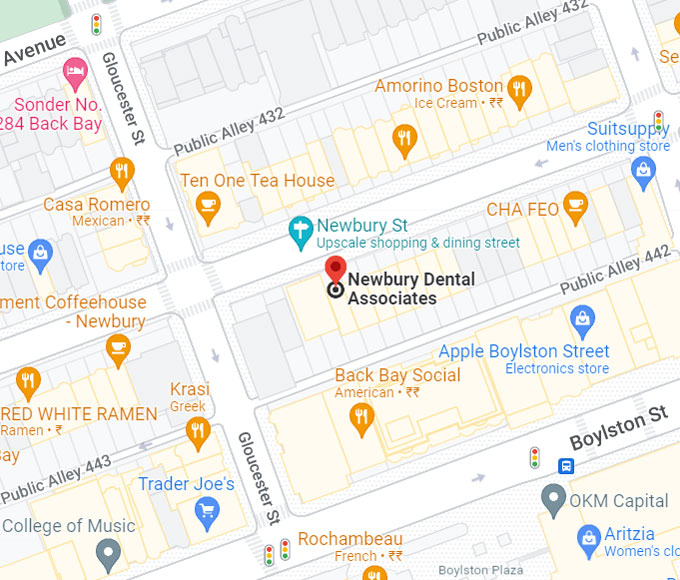
Now welcoming patients from Gentle Dental Boston.
Several parking lots located around Newbury Street, along with parking garage behind building. Street parking is available, but limited.
Now welcoming patients from Gentle Dental Boston.
Several parking lots located around Newbury Street, along with parking garage behind building. Street parking is available, but limited.
Boston

I went to Newbury Dental for treatment of an open bite that was causing severe TMJ pain and other issues when trying to fully close my bite. I told Dr. Bahadoran that I wanted to correct it as quickly as possible, and she was able to fix it in less than two months. The treatment process was very straightforward, and the scheduling team was always accommodating and able to get me in, even when things came up unexpectedly. I would definitely recommend the orthodontic department here to anyone looking for fast, effective results and a staff that is attentive, supportive, and dedicated.
Boston
The best professional courteous very gentle I didn’t feel anything .
Boston
I broke a tooth over the weekend and called Monday and was given an appointment same day, the excellent dentist explained the process to remove most of the remaining tooth and fit a temporary crown, and make a cast for the permanent crown to be fitted in two weeks. Treatment was quick, effective and pain free
The temporomandibular joints connect the lower jaw to the skull and allow the jaw to move when you talk, chew, and open your mouth. TMD refers to conditions that affect these joints, the surrounding muscles, or other structures involved in jaw movement.
Not every jaw sound or occasional ache means you have a disorder. Persistent pain or changes in jaw function, however, are worth evaluating.
Jaw pain may occur around the joint near the ear or in the muscles of the face. Some patients notice that discomfort becomes worse when chewing tougher foods, yawning, or opening the mouth widely.
TMD can sometimes make the jaw feel stiff or restrict how widely the mouth opens. In some cases, patients may also experience episodes in which the jaw temporarily feels locked or difficult to move normally.
Clicking and popping sounds can occur when the jaw moves. Sounds that occur without pain or restricted movement do not necessarily require treatment.
If clicking is painful or occurs with stiffness, locking, or difficulty chewing, a dental evaluation can help determine whether further care is appropriate.
One reason Boston TMJ treatment should begin with an evaluation is that TMD symptoms can have different contributing factors.
Grinding or tightly clenching the teeth can place additional stress on the chewing muscles and teeth. Because grinding often happens during sleep, some patients do not realize they are doing it.
Morning jaw soreness, headaches, tooth sensitivity, or signs of tooth wear may lead your dentist to evaluate whether bruxism is contributing to your symptoms.
Previous trauma to the jaw or face may affect the temporomandibular joint. Arthritis and problems involving the structures within the joint can also contribute to pain or restricted movement.
Repeated jaw clenching, gum chewing, nail biting, and other habits can place additional strain on the jaw muscles.
Stress can also be associated with increased muscle tension or clenching in some patients. Identifying these patterns may be useful when planning care.
There is no single test that determines the cause of every patient's jaw pain. Your dentist considers your symptoms, dental history, jaw movement, and clinical findings before recommending treatment.
Your dentist may ask when the discomfort started, where you feel it, whether the symptoms come and go, and which activities make them better or worse.
Mention symptoms such as:
These details can help your dentist understand the pattern of your symptoms.
Your dentist may observe how your jaw opens and closes, check your range of motion, and examine areas around the jaw for tenderness.
The jaw joints may also be checked for clicking, popping, or other changes during movement.
Dental X-rays or other imaging may sometimes be recommended depending on your symptoms and examination findings.
Imaging can provide additional information about the teeth, jaw, and surrounding structures when a clinical examination alone does not provide enough information.
Treatment depends on what appears to be contributing to your symptoms. Many TMD problems are initially managed using conservative approaches rather than procedures that permanently change the teeth, bite, or jaw.
During periods of discomfort, your dentist may discuss temporary changes that reduce unnecessary pressure on the jaw.
Depending on your situation, recommendations may include choosing softer foods for a short period, avoiding gum chewing, limiting very wide jaw movements, or becoming more aware of daytime clenching.
If grinding or clenching is contributing to your symptoms, an oral appliance may be discussed.
A custom mouth guard or splint fits over the teeth and may be used in certain situations to protect the teeth or help manage problems associated with bruxism.
An appliance is not appropriate for every TMD patient, so your dentist should first evaluate the likely cause of your symptoms.
Some patients may benefit from exercises or physical therapy designed to support jaw movement and muscle function.
If your symptoms are persistent, complex, or appear to involve problems requiring care outside general dentistry, additional evaluation or referral may be recommended.
Jaw problems can sometimes occur alongside symptoms that seem unrelated to the teeth.
Some patients with TMD report headaches, facial pain, neck discomfort, or aching around the ear. However, these symptoms can also result from many other medical or dental conditions.
For that reason, recurring headaches or ear-area discomfort should not automatically be assumed to come from the TMJ. An appropriate dental or medical evaluation can help identify the source.
If your jaw becomes temporarily sore or stiff, reducing stress on the area may help while you arrange an evaluation.
Depending on your individual condition, simple measures may include:
These measures should not replace professional evaluation when pain persists, jaw movement becomes limited, or symptoms continue to interfere with everyday activities.
More invasive treatment is not usually the first step for uncomplicated TMD symptoms.
When conservative treatment does not provide adequate improvement, your dentist or another healthcare professional may discuss additional options based on the specific diagnosis.
Persistent jaw locking, significant limitation of movement, structural joint problems, or severe symptoms may require further evaluation by a provider with additional experience in temporomandibular disorders or oral and maxillofacial conditions.
Gentle Dental Newbury St. provides comprehensive dental care in Boston, including TMD/TMJ evaluation and treatment.
Receiving dental care in a multi-service office can also help your dental team consider other oral health factors when evaluating jaw symptoms, including tooth wear, grinding, bite concerns, and overall dental health.
If jaw pain, stiffness, clicking, or difficulty chewing is affecting your daily routine, schedule an evaluation at Gentle Dental Newbury St. to determine the appropriate next steps.
Take care of your smile with a modern, reliable approach to dentistry. Our experienced team creates a welcoming, comfortable environment for expert dental services on Newbury Street, from routine check-ups to advanced care.
Gentle Dental in Newbury St. provides TMD/TMJ treatment in Boston. A dental evaluation can help determine whether your jaw pain, stiffness, clicking, or other symptoms may be related to a temporomandibular disorder and what type of care may be appropriate.
A dentist can evaluate many symptoms associated with TMD, including jaw pain, teeth grinding, painful clicking, and difficulty with jaw movement. If your condition requires additional expertise, your dentist may recommend referral to another healthcare professional.
Jaw pain alone does not confirm that you have TMD. Symptoms may include pain around the jaw joint or chewing muscles, stiffness, limited movement, locking, or painful clicking and popping. An examination is needed because other dental or medical problems can produce similar symptoms.
TMD can sometimes be associated with headaches and facial or neck discomfort. Because headaches have many possible causes, recurring headaches should be properly evaluated rather than automatically attributed to the jaw.
Some people with TMD experience aching or discomfort around the ear because the jaw joints are located nearby. However, ear pain can have other causes, so persistent symptoms should be evaluated by an appropriate healthcare professional.
Coverage varies according to your insurance plan and the treatment recommended. TMJ-related services may be handled differently under dental and medical insurance, so it is important to review your individual benefits before treatment.
If your request is a dental emergency, or you would like to call and schedule your dental appointment, contact information for our offices can be found here: Gentle Dental Locations. New patient offer not valid for emergency appointments.

It’s a good thing we can open and close our mouths so that we can do the things ...

