New Patient Offer
$79
A $400+ Value
- Exam
- X-rays
- Cleaning
- Treatment Plan


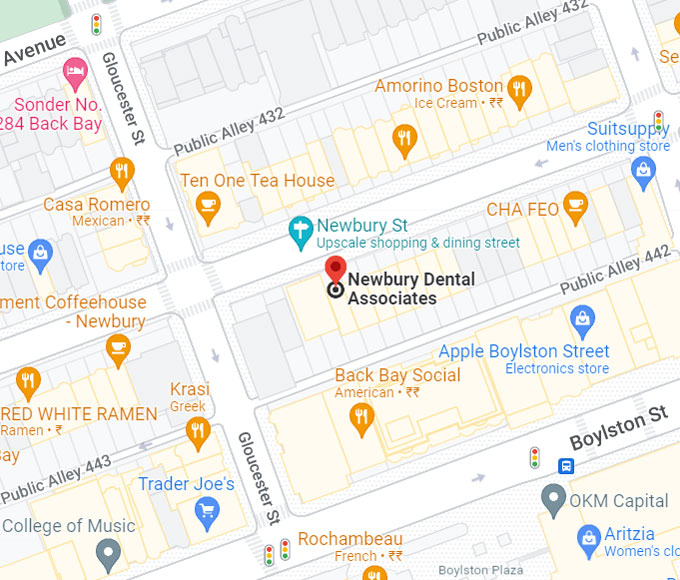
Now welcoming patients from Gentle Dental Boston.
Several parking lots located around Newbury Street, along with parking garage behind building. Street parking is available, but limited.
Now welcoming patients from Gentle Dental Boston.
Several parking lots located around Newbury Street, along with parking garage behind building. Street parking is available, but limited.
Boston

had both of my wisdom teeth extracted by Dr. Shadi Daher, and I cannot say enough good things about my experience.
Boston
I had to get my wisdom teeth removed and I'm very thankful for Dr. Shadi Daher! I'm a very nervous person when it comes to medical procedures, but Dr. Daher made the procedure very easy for me. Him and the staff at Newbury Dental answered all my questions (which I had many). Thank you!
Boston
I went in for my wisdom tooth extraction for the first time in Boston. The staff was amazing! Dr.He took care of me like a true doctor takes care of his patient. Will definitely recommend this practice to anyone. Dr.Syed
Wisdom teeth are the third and final set of molars located at the very back of the mouth. Some people have enough room for these teeth to grow into a healthy position, while others develop wisdom teeth that only partially emerge or remain trapped beneath the gums or jawbone.
A wisdom tooth that does not fully erupt is known as an impacted wisdom tooth. Impacted or partially erupted wisdom teeth can sometimes contribute to pain, swelling, infection, tooth decay, gum problems, or damage to nearby teeth.
Not every wisdom tooth needs to be removed. A dental examination can help determine whether your wisdom teeth can remain in place safely or whether extraction should be considered.
Wisdom tooth problems do not always cause symptoms immediately. Regular dental exams can help monitor the position and development of these teeth before significant discomfort develops.
Pain or pressure behind the second molars may develop when a wisdom tooth is erupting, impacted, or affecting the surrounding tissues.
The discomfort may be constant or may become more noticeable while chewing or opening your mouth.
The gums around a partially erupted wisdom tooth can become swollen, tender, or difficult to clean.
When part of the tooth remains covered by gum tissue, bacteria and food particles may collect in the area, increasing the risk of inflammation or infection.
Impacted or inflamed wisdom teeth may sometimes be associated with discomfort toward the back of the jaw or difficulty opening the mouth comfortably.
Persistent jaw stiffness or swelling should be evaluated rather than assumed to be a normal part of wisdom tooth development.
Wisdom teeth are located far back in the mouth, which can make brushing and flossing more difficult.
If a tooth erupts only partially or at an angle, keeping the area clean may become even more challenging. This can contribute to cavities or gum problems around the wisdom tooth and neighboring teeth.
An impacted wisdom tooth is a third molar that does not fully emerge into the mouth because its path is blocked by bone, gum tissue, another tooth, or limited space in the jaw.
Wisdom teeth may be fully covered by bone or soft tissue, or they may partially emerge through the gums. The position and depth of the tooth can influence how it needs to be removed.
An impacted tooth does not automatically need extraction simply because it is impacted. Your dentist or oral surgeon will consider its position, symptoms, surrounding tissues, and potential effects on nearby teeth before recommending treatment.
The approach to wisdom teeth extraction in Boston depends largely on how the tooth has developed and whether it has fully erupted.
A simple extraction may be possible when the wisdom tooth has fully erupted through the gums and can be accessed normally.
Local anesthesia is typically used to numb the treatment area before the tooth is removed. Gentle Dental notes that whether a wisdom tooth can be removed through a simple extraction or requires oral surgery depends on whether it has erupted or remains impacted.
A surgical extraction may be needed when a wisdom tooth remains partially or completely beneath the gum or jawbone.
The exact procedure depends on the tooth's position and complexity. Your dental team can review the procedure, anesthesia considerations, and expected recovery before treatment.
Your first step is an evaluation rather than automatically scheduling an extraction.
Your dentist will examine the back of your mouth and look for signs of swelling, infection, decay, gum problems, or changes involving nearby teeth.
You should also discuss any current symptoms, medications, medical conditions, or previous dental treatment with your dental team.
Dental X-rays may be used to determine the position of your wisdom teeth and evaluate how they relate to the surrounding teeth and jaw.
Imaging can also help the dental team determine whether a tooth has erupted normally or remains partially or fully impacted.
After the examination, your dentist or oral surgeon can explain whether removal is recommended and what type of extraction may be appropriate.
Some wisdom teeth can continue to be monitored if they are healthy and are not creating problems.
The exact procedure depends on whether the wisdom tooth is fully erupted or impacted.
Before treatment begins, appropriate anesthesia is used to help control discomfort. For surgical extractions, the oral surgeon may need to access a tooth located beneath the gum tissue or bone before carefully removing it.
Your dental team will explain what to expect based on the number, position, and complexity of the wisdom teeth being treated.
Healing is different for every patient, and recovery instructions should be followed carefully after your procedure.
Some swelling, soreness, and temporary discomfort can occur after wisdom tooth extraction. Boston-area hospital guidance notes that pain and swelling can be most noticeable during the first few days following an extraction.
Your dental team will give you specific instructions based on your treatment.
A blood clot forms in the extraction site and plays an important role in the healing process.
Avoid disturbing the area and follow your dentist's instructions regarding rinsing, brushing, eating, and other activities after treatment. Loss or disruption of the blood clot can contribute to a painful condition known as dry socket.
Your dental team may recommend softer foods during the early stages of recovery.
Avoid foods or habits that could irritate the extraction area until your dentist advises that you can return to your normal routine.
Take any recommended or prescribed medications exactly as directed and follow all aftercare instructions provided by your dental team.
Contact the office if you have concerns about your recovery or develop symptoms that seem unusual or are becoming worse.
No. The presence of wisdom teeth alone does not mean that extraction is necessary.
Some wisdom teeth erupt into a healthy position, can be cleaned effectively, and do not interfere with surrounding teeth or gums.
Removal may be considered when a wisdom tooth is impacted, diseased, difficult to maintain, or contributing to problems such as pain, infection, decay, or damage to nearby structures.
Your dentist can monitor wisdom teeth over time and recommend treatment based on your individual dental health.
Wisdom tooth development is often monitored during the teenage and young adult years.
A patient does not always need to wait for significant pain before having wisdom teeth evaluated. Dental imaging and regular examinations can help identify teeth that are developing in a position that may require closer monitoring or treatment.
Parents and young adults in Boston can discuss the development of wisdom teeth with the dental team at Gentle Dental Newbury St. during routine visits or a dedicated consultation.
Gentle Dental Newbury St. provides comprehensive dental care at 274 Newbury St., Boston, MA 02116. The location offers oral surgery services, including tooth extractions, allowing patients to receive evaluation and appropriate treatment within a multi-service dental practice.
Having general dentistry and oral surgery services available within the practice can also help coordinate your care before and after an extraction.
Whether you are experiencing wisdom tooth pain or your dentist has recommended having your third molars evaluated, the Newbury Street team can determine the appropriate next steps based on your oral health and the position of your wisdom teeth.
Take care of your smile with a modern, reliable approach to dentistry. Our experienced team creates a welcoming, comfortable environment for expert dental services on Newbury Street, from routine check-ups to advanced care.
Wisdom teeth may need evaluation if you experience pain, swelling, infection, difficulty cleaning around the tooth, or problems involving nearby teeth or gums. Dental X-rays can help your dentist assess the position of the teeth and determine whether extraction is recommended.
No. Treatment depends on the tooth's position, symptoms, and effect on surrounding tissues and teeth. Some impacted wisdom teeth may be monitored, while others may need removal if they are causing or are likely to contribute to dental problems.
A simple extraction may be used when the wisdom tooth has fully erupted and can be accessed normally. Surgical extraction may be necessary when the tooth is partially or completely impacted beneath gum tissue or bone.
In some cases, multiple wisdom teeth may be removed during the same procedure. Whether this is appropriate depends on the position and condition of the teeth, the complexity of treatment, and your individual health needs.
Recovery varies from person to person and depends on the complexity of the extraction. Swelling and discomfort are commonly more noticeable during the first few days, while healing continues afterward. Follow the recovery instructions provided by your dental team.
Your dentist or oral surgeon may recommend softer foods during the early stages of healing. Follow the specific instructions provided after your procedure and avoid foods or habits that could irritate or disturb the extraction site.
Dry socket can occur when the blood clot protecting the extraction site does not develop properly or becomes dislodged. This can lead to significant pain and delayed healing. Contact your dental office if you experience severe or worsening pain after an extraction.
If your request is a dental emergency, or you would like to call and schedule your dental appointment, contact information for our offices can be found here: Gentle Dental Locations. New patient offer not valid for emergency appointments.

You probably know someone who has had a tooth extraction, as it is a common dent...

How much to pull a tooth? Tooth extraction costs can vary based on the type of t...

What is a wisdom tooth?Although wisdom teeth have nothing to do with wisdom, it ...

