New Patient Offer
$79
A $400+ Value
- Exam
- X-rays
- Cleaning
- Treatment Plan


For many, cost can make it challenging to complete necessary dental treatment. In fact, about 13% of the population reported cost getting in the way of dental care, compared to 4-5% for other health care services, according to the American Dental Association (ADA). The good news is that inexpensive dental services without compromising quality care is within reach through the options this guide covers.

We'll discuss factors patients should consider when choosing the right affordable and accessible dental provider. Gentle Dental offers affordable dental care for families at convenient locations throughout Massachusetts and New Hampshire. We offer high-quality, low-cost visits with flexible payment options including promotions and new patient offers, third-party financing, savings plans, numerous accepted insurances, and low-cost alternatives that fit your budget and needs.
We also provide accessibility accommodations for patients in need to make care as comfortable as possible. Our preventative care visits can help you avoid the need for more complex and costly future problems.
Cost and access to care are often the main reasons people delay dental treatment. Gentle Dental understands and emphasizes that dental care should be both affordable and accessible, meaning that care is both financially achievable and easy to receive. Affordable dental care involves low-cost visits, flexible payment and savings plans, wide acceptance of insurance coverage, and reduced out-of-pocket costs.
Accessible dental care can include location convenience, mobility support, language support, special-needs accommodations, and easier appointment access. At Gentle Dental, high-quality care is still a part of low-cost dental care. This guide offers patients practical options and a better understanding of dental procedures and costs that can fit your budget and lifestyle.
Affordability and accessibility are both important when choosing dental care, but they have different meanings. Affordability refers to how dental costs fit your budget, including insurance coverage, payment plans, and other financial options. Accessibility refers to how easy it is to receive care, such as the clinic's location, appointment availability, wheelchair access, language assistance, and accommodations for other needs.
A dental clinic may offer lower-cost treatment but be difficult to reach or unable to meet your needs. Another clinic may be conveniently located and well equipped for special accommodations, but cost more. Choosing a dental clinic that is both affordable and accessible can make it easier to get regular care and support better long-term oral health.
Unfortunately, dental care barriers still make it difficult for many individuals and families to get the treatment they need. High out-of-pocket costs, limited or no dental insurance, few nearby providers, and transportation or mobility challenges can prevent patients from scheduling or completing care.
These challenges often affect underserved communities at higher rates, including children, older adults, rural residents, low-income families, racial and ethnic minority groups, and people with special needs. Improving dental access through affordable, convenient, and accommodating dental clinic options is important because oral health supports overall health.
Delaying dental care can allow issues like cavities or gum disease to become more painful, complex, and expensive to treat.
The cost of dental care can leave many patients asking, “Why is dental care so expensive?” Treatment delays often happen when patients are unsure what their care will cost or do not have a manageable way to pay the total cost. Uninsured and underinsured patients may face high out-of-pocket costs, making cost one of the biggest barriers to receiving needed treatment.
Luckily, many dental offices offer flexible payment options to help patients plan for care, whether they have insurance, limited insurance, or no insurance at all. Your dental team can also discuss cost estimates with you before you begin treatment so that you can prepare ahead of time and avoid delaying important dental care.
Even when costs are manageable, accessing dental care can still be challenging. Common barriers include limited transportation to dental offices that are far away, long wait times, and scheduling conflicts.
Some patients may also need accommodations, such as disability-accessible spaces, language or communication support, or specialized equipment to meet other needs. These challenges can make it more difficult to obtain and complete necessary dental care.
A truly affordable dentist offers transparent pricing upfront before treatment and answers your questions so that you can make informed decisions about your care. Look for clear fees for services, cost estimates, accepted insurances, and self-pay policies.
You can also ask about available financing options, new-patient offers, sliding fees, in-office payment plans, or a dental savings plan for patients without insurance. Reviewing all your financial options ahead of time can make dental care more manageable.
Dental providers who provide transparent pricing typically explain costs in advance. They should review the expected fees for exams, cleanings, X-rays, and any recommended treatment before it is performed. Ask for an itemized estimate and treatment breakdown so that you can clearly understand your expected out-of-pocket costs, what insurance may cover, and whether additional payment options are available.
Dental offices may offer several ways to pay for care, including insurance, membership plans, payment plans, and self-pay options. Insurance plans commonly involve paying premiums in return for reduced out-of-pocket costs for eligible dental services at participating dental offices. If you have dental insurance, ask your insurance provider and dental office whether your plan is accepted by their office and what coverage benefits you have.
If you do not have insurance, ask about self-pay pricing, special promotions, financing and payment plans, or dental membership programs. Some offices may offer special promotions or discounts for treatment to help reduce out-of-pocket costs for care.
Patients may have the option to self-pay for treatment, which requires paying the office directly for your visit and treatment. Some offices accept membership plans, which typically provide reduced treatment fees for a membership fee.
While, payment plans may be available for eligible treatment, which involves dividing the total costs into smaller scheduled payments, sometimes through the office or a third-party financing company. It's important to review all your payment options and clinic estimates for your recommended treatment so that you can make an informed cost decision before beginning treatment.
Not sure which payment option fits your budget? Ask our team for a free, no-obligation estimate.
Pricing/Options Comparison Chart
| Payment option | How it works |
|---|---|
| Dental insurance |
|
| Self-pay |
|
| Membership plan |
|
| Payment plan |
|
Dental insurance can lower your out-of-pocket costs for treatment, which can make dental care more adorable and accessible. It's important to clarify with your dentist and insurance provider estimated coverage costs and your expected out-of-pocket costs, copays, deductibles, waiting periods, annual benefit limits, and provider network requirements (in-network vs out-of-network) if applicable.
You can also ask about Medicaid and Medicare-related assistance if needed. Each accepted insurance plan may vary by clinic. Before booking your appointment, ask whether the clinic is in-network and whether your planned service is covered to help you avoid unexpected costs.
Dental insurance can help reduce your out-of-pocket costs and make receiving dental care feel more manageable. Preventive care, such as exams, cleanings, and X-rays typically have lower costs than restorative or specialty services like crowns, root canals, dentures, or implants. It's important to check your plan's specific coverage details, as eligibility and benefits vary from plan to plan.
Before you book your appointment, contact both your dental office and insurance company to confirm that the provider participates in your plan and is in-network. Ask about annual maximums, deductibles, and whether your planned treatment requires prior authorization.
No need to delay dental care due to costs. If costs are getting in your way, ask about affordable treatment options like payment plans, discounts, and special programs. Some offices accept a dental savings plan, which works like a membership program, where members receive discounted rates for eligible dental services with varying rules specific to each plan. Many offices provide low-cost dental treatment and flexible payment options to help manage costs over time.
A dental savings plan is typically modeled like a standard membership plan, involving paying an annual fee in exchange for discounted services, and reduced upfront costs at participating dental offices. However, it's important to note that a dental savings plan is not the same as insurance.
The main difference is that with a dental savings plan, you generally directly pay the office a discounted fee for each eligible service rather than having an insurance company pay a percentage of treatment. Be sure to ask the details of available dental savings plans, including which services are included, whether there is a waiting period, and your estimated treatment costs.
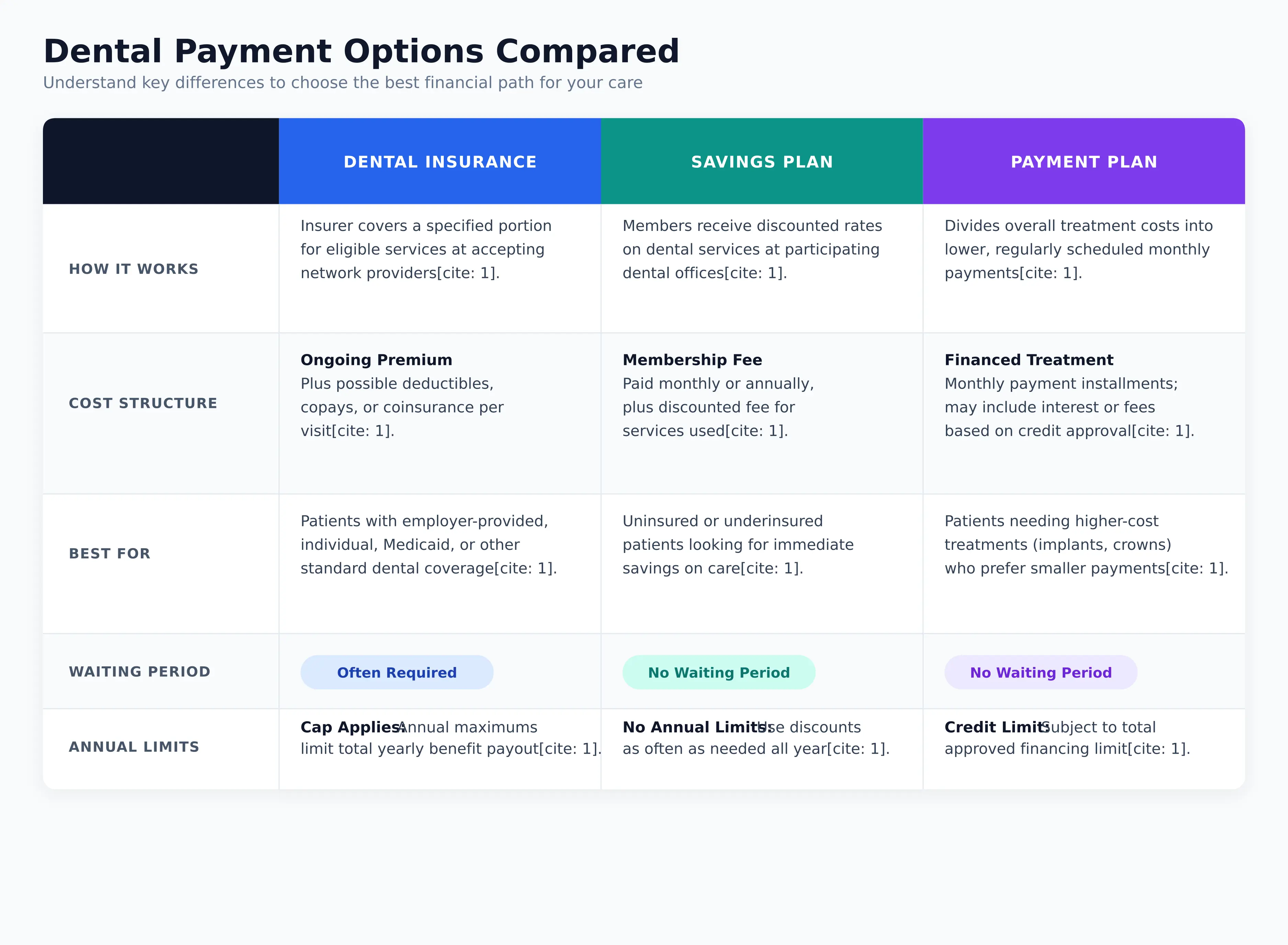
Payment plans may help spread costs over time when you need dental treatment but cannot comfortably pay the full cost upfront. They can divide costs into smaller monthly payments, which makes dental care more affordable for many individuals. This can be particularly helpful for treatments with higher fees like implants, crowns, bridges, and dentures. The terms of each payment plan can vary between providers or financing companies, so it's important to verify all information before choosing a plan, including any interest rates, fees, payment schedule, and whether credit approval is required.
| Dental Insurance | Dental Savings Plan | Payment Plan | |
|---|---|---|---|
| How it works | Insurer covers a specified portion for eligible dental services based on plan at accepting providers | Members are offered discounted rates on dental services at participating offices | Divides treatment costs into lower scheduled payments |
| Cost | You pay a premium, plus possible deductibles, copays, or coinsurance | You pay monthly or annual membership fee, plus other possible fees | Often involves monthly payments, possible interest depending on financing requirements |
| Beneficial for | Patients with employer, individual, Medicaid, or other dental coverage | Uninsured or underinsured patients | Patients who need smaller payments |
| Waiting Period | Often requires a waiting period before insurance kicks in | No waiting period | No waiting period |
| Annual Limits | Often applies | Usually no limits, but rules can vary | Financing limits may apply |
Affordable dental services often include preventive, restorative, and specialty or compassionate care for individuals who require specific accommodations. Continue reading below for more details:
Prevention is often the most effective and affordable path to supporting long-term oral health. Preventive care typically includes routine dental exams, oral cancer screenings, cleanings, x-rays, sealants, and fluoride treatments. Preventive dental treatment helps protect and detect any issues early before they progress and require more complex and costly treatment.
Common restorative treatments include fillings, simple extractions, root canals, crowns, bridges, implants, and dentures. Restorative care treats a variety of issues such as oral pain, cavities, gum disease, infection, dental trauma, and tooth loss. Early treatment can prevent problems from worsening and the future need for more extensive and costly dental treatment.
Some dental offices offer additional support services or specialized care options for patients in need, such as patients with disabilities, patients with complex medical conditions, and people who feel nervous about dental care. Common services include special-needs support or dental sedation options to ease anxiety and make visits more comfortable. Before your appointment, inform your dentist of any specific accommodations needed that would make your visit smoother.
Making patient access to dental care easier is key to helping reduce barriers to dental care. An accessible office provides compassionate care that goes beyond just offering lower prices, but also makes it easy to get care. Thankfully, many dental offices provide accessible care and special-needs support. Special accommodations often include mobility access from parking to treatment rooms, sensory-friendly care, language assistance, and support for patients with disabilities or complex needs.
When gathering more information about a dental clinic, determine if there are accommodations like convenient parking, wheel-chair accessible entrances, and clear paths through the waiting and treatment rooms. These conveniences can be particularly important for patients with physical and mobility challenges and their caregivers who provide support.
Ask about sensory, language, or communication support if in need. Many dental offices provide interpreter support, patient-friendly explanation styles like written and visual aids, or other communication accommodations when requested. Offices may also provide reduced lighting, comfort blankets, or headphones to make your visit as comfortable as possible. Longer appointments may be recommended for patients who need extra time or would benefit from breaks during treatments.
Many dental offices provide resources and treatment accommodations for patients with anxiety, mobility issues, medical conditions, or other complex health needs. Inform your dental team of your health history and if you need any special accommodations so that you can receive adequate and comfortable care. The dentist may recommend sedation options, longer appointments, or extra guidance to ensure you receive safe and quality dental care.
Affordability doesn’t have to mean lower standards or quality. At Gentle Dental, our team of dental experts provide high-quality dental services and evidence-based care that is patient-centered at affordable prices. We focus on prevention, personalized treatment planning, and safe and efficient care for long-term oral health. If you’re searching for an affordable trusted provider and quality dental care, Gentle Dental is your match.
Low-cost dental options should not equate to lower standards of care. When comparing your dental provider options, review the provider’s credentials, services offered, and patient reviews to help you choose the best fit for you. Look for providers with appropriate licensing credentials, clear cost estimates, and the necessary accommodations to meet your needs.
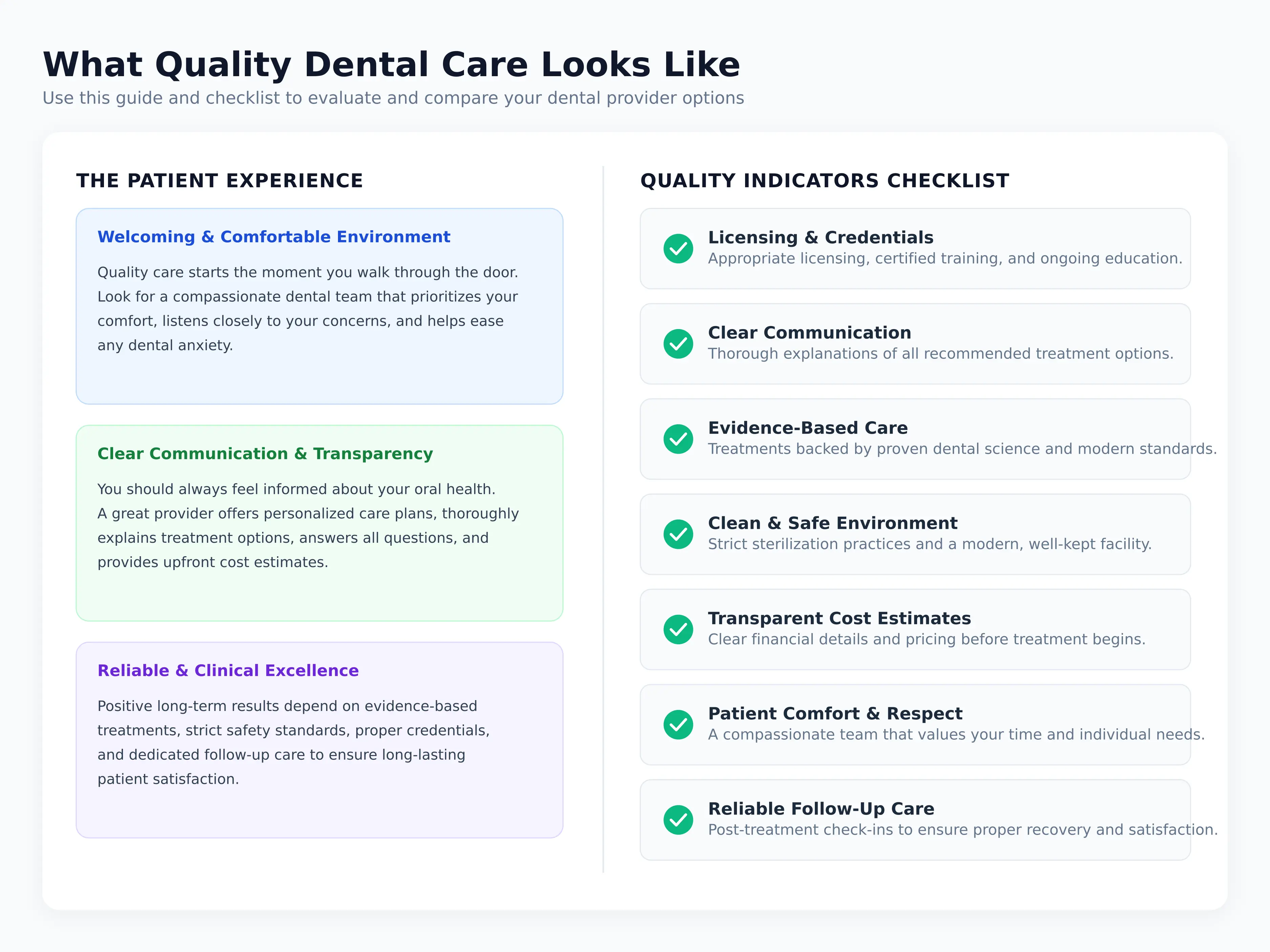
Quality dental care is not only about nice treatment results, but also how patients feel throughout their dental care. Positive reviews and testimonials typically show patient satisfaction, including feeling welcomed and comfortable, understanding recommended treatment options and clear communication overall, and seeing reliable treatment results. Look for a dental team that personalizes your care and takes time to listen and answer your questions and concerns.
Here’s a quick checklist to run through when comparing your dental provider options:
Quality Indicators Checklist:
☐ Appropriate licensing and training credentials
☐ Clear explanations for treatment options and overall communication
☐ Evidence-based care
☐ Clean and safe environment
☐ Transparent cost estimates
☐ Patient comfort and respect
☐ Reliable treatment follow-up
Reviews can offer helpful insight into a dental practice, including communication, affordability, and overall atmosphere. However, they are only part of the story and should be considered alongside other factors, such as your own personal experiences and whether the practice meets your individual needs when choosing a dentist.
Before making a decision, contact the dental offices you are considering to learn more about them and determine if they are a good fit for you.
Reviews can be a valuable resource when you are looking for a dental provider who is welcoming, efficient, and reliable. However, it’s important to keep in mind that every patient’s experience is unique, and reviews should be only one part of your decision.
Contact your dental options directly to learn more about their treatment services, insurance and payment options, special accommodations, and appointment schedule. Also ask any questions you may have so that you can have a clearer idea of what to expect from the practice.
Avoid delaying dental care to help protect your overall health. Get started with affordable dental care by first getting in contact with a trusted dental provider. Gentle dental welcomes new patients and offers convenient, affordable, high-quality dental care for individuals and families.
Our friendly team is here to answer your questions, explain insurance and payment options, help with scheduling, and make your visit as comfortable as possible. Schedule an appointment today!
When preparing for your appointment, think about whether you need preventive care, urgent care, or restorative treatment. Preventive care includes routine dental check-ups and cleanings, which is recommended at minimum twice a year, or more frequently depending on each individual’s treatment plan and dentist’s recommendations.
Urgent care may involve oral pain, swelling, trauma, tooth decay, or infection that requires immediate evaluation and treatment to prevent serious health complications. While restorative care may include fillings, crowns, bridges, implants, or dentures. Before contacting a clinic, prepare to discuss your symptoms and concerns, any medical history, and your dental insurance information if you have any.
Have a checklist of questions ready to ask when you call, such as the cost of your visit, accepted insurance plans, payment options, expected wait times, and availability of any accommodations needed. Also ask whether treatment estimates can be provided before care begins so that you can plan ahead.
Gentle Dental is here to make your first visit a breeze. Contact our caring team members to make an appointment and learn more about what to expect and bring. New patients may need a photo ID, such as a valid driver's license, state ID, or passport. If you have dental insurance, bring your current dental insurance card and any necessary forms.
Prepare in advance a list of your medication names and dosages, allergies, and any medical conditions or surgeries. You can also bring with you any previous dental records or X-rays if available.
On the day of your visit, brush and floss your teeth. Arrive a little earlier than your scheduled time to complete paperwork, and discuss costs, your treatment, and any questions you may have. Once your comprehensive examination is complete, our team of dental professionals will develop a personalized treatment plan and discuss follow-up visits for long-term oral health.
Ready to get started? Schedule your appointment with Gentle Dental today.
Local dental care can make it easier to stay on top of your oral health. Choosing a nearby dental clinic, community care center, or provider within your service area may reduce travel time, transportation costs, and scheduling stress.
This added convenience can also support better follow-through with completing care. Community dental programs often help make care more accessible and affordable, though eligibility and services can vary. Some may serve specific counties, cities, or special populations.
Routine dental care supports both oral and overall health. Choosing a dental office near your home, workplace, school, or a public transportation route can help reduce missed appointments and make it easier to stay on track with your care. It may also lower travel costs. Finding a professional care team that offers comprehensive dental services is especially valuable for people living in underserved or rural communities.
Community dental programs are valuable resources that provide a wide range of dental services and oral health education to keep smiles healthy. These programs are designed to be budget-friendly and easy to access, which can be especially helpful for populations who are more likely to face barriers to care, like children, older adults, low-income families, people without dental insurance, and families living in rural areas.
Community outreach services may include mobile dental clinics that travel to schools or community health centers. State programs in Massachusetts and New Hampshire offer many of these options, each with their own unique available services, to help everyone receive dental care.
When you choose a dentist, look for an affordable and accessible dental provider who provides patient-centered care. An affordable dental clinic not only provides transparent pricing, but also ensures quality, convenience, and comfort.
When reviewing your dental provider options, compare factors like cost, accepted insurance plans, available dental services, accessibility accommodations, patient reviews, and appointment times before making your decision. Once you’ve found the right provider for your needs, contact them to begin care.
When reviewing your options, compare affordability, access, and quality side by side to help you choose the right dental provider. Here's a quick checklist to use to help you weigh your options:
| Comparison Factors | Provider A | Provider B | Provider C |
|---|---|---|---|
| Cost and Affordability | |||
| Takes my insurance (in-network vs out-of-network) | □ | □ | □ |
| Provides insurance and billing assistance throughout care | □ | □ | □ |
| Gives a written cost estimate before treatment | □ | □ | □ |
| Offers payment plans, membership plans, or discounts | □ | □ | □ |
| Explains lower-cost treatment options when appropriate | □ | □ | □ |
| Location and Accessibility | |||
| Easy to reach from home, work, school, or public transit | □ | □ | □ |
| Has accessible parking, entrances, and treatment areas | □ | □ | □ |
| Offers language help or other accommodations if needed | □ | □ | □ |
| Appointments | |||
| Accepting new patients | □ | □ | □ |
| Offers convenient hours for your schedule | □ | □ | □ |
| Can see urgent problems quickly | □ | □ | □ |
| Support Services | |||
| Listens to concerns and explains treatment and patient education clearly | □ | □ | □ |
| Offers options for anxiety, comfort, or special care needs | □ | □ | □ |
| Provides preventive, restorative, and emergency dental services you may need | □ | □ | □ |
To choose the right dental provider, start by finding a team that’s welcoming, knowledgeable, and makes starting care simple. The best providers make it easy to ask questions and support your needs. Call or schedule a visit if cost, coverage, or accessibility is unclear. Gentle Dental of New England provides patient-centered care throughout Massachusetts and New Hampshire.
Affordable dental care can include preventive, restorative, and supportive services. Preventive visits (i.e. exams, oral cancer screenings, cleanings, X-rays, sealants, and fluoride treatments) help find problems early and may reduce the need for future complex and costly care. Restorative treatment may include fillings, simple extractions, root canals, crowns, bridges, implants, and dentures. Some practices also offer sedation or anxiety-relief options and accommodations for patients with mobility, sensory, language, cognitive, or special medical needs.
Dental savings plans are different from dental insurance. A dental savings plan offers discounted rates that you pay directly to participating dentists on eligible dental services for a yearly membership fee. Whereas, dental insurance plans offer to pay a percentage of eligible dental services in exchange for paying a monthly or annual premium. Gentle Dental accepts over 200 dental insurance plans and Essential Dental Plan, a dental savings plan.
Gentle Dental accepts more than 200 dental insurance plans including Delta Dental, MetLife, BlueCross BlueShield, Guardian, Cigna, Aetna, Altus, Assurant, and United Concordia. Contact one of our offices to help verify your insurance coverage and discuss all available payment options.
Absolutely! You can still receive dental care at Gentle Dental without insurance and there are several available payment options. Gentle Dental also offers promotions and discounts, payment plans, and flexible financing with CareCredit and Sunbit. Our new patient offer includes a discounted exam, all necessary x-rays, treatment plan, and cleaning. Gentle Dental also accepts Essential Dental savings plan.
Each Gentle Dental office provides accommodations and specialized resources for all patients in need. Inform our offices of any medical, physical, sensory, or communication needs before your appointment. Our caring team can answer any questions you may have and provide you with information on accessibility accommodations such as wheelchair access, parking, treatment room design, specialized sedation methods, and anxiety-reducing techniques.
To schedule a new-patient appointment at Gentle Dental of New England, visit our website online or call your preferred local office and speak with one of our friendly team members. With 45+ locations in Massachusetts and New Hampshire, we offer comprehensive dental services for you and your entire family.

Searching for teeth whitening products that actually work? Your dentist is the…

Dental implants play an important role in supporting your overall dental health…

Understanding how oral health affects overall health can help you protect your…
49 Convenient Locations throughout Massachusetts and New Hampshire